
Defining, Creating, & Enforcing Your Minimum Advertised Price (MAP) Strategy

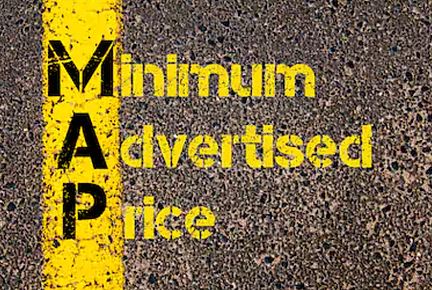
Are you ready to protect your profit margins, reinforce your brand image and ward off resellers who always go for the pricing jugular? Chances are you’ll benefit from a minimum advertised price (MAP) policy.
What is MAP?
These agreements lay a foundation between brand and retailer that protects both sides and makes for a mutually beneficial relationship.
In its most basic definition, a MAP is the lowest amount a seller can publicly market your product. If you set MAP for an electric toaster at $22, sellers are not allowed to show any price lower than $22 when they advertise your toaster online or off.
There may be other places, however, where a lower price is visible (including inside a physical store, in an online shopping cart) because those locations are not forward-facing/public.
The biggest benefits of using a MAP are:
Stabilizes pricing among all sellers
Maintains brand identity
Levels the playing field between small sellers and larger retailers
Prevents underpricing
Controls and protects profit margins
Satisfies authorized distributors
How MAP Protects Your Brand Across All Retail Channels
MAP was likely derived out of a need to protect a brand’s image as well as their profits. And it’s a great idea! All online marketplaces are not the same. If you ask someone on the street where they think they’ll get the lowest price (Walmart or Etsy) they will almost certainly answer “Walmart.”
That’s because, while Etsy is all about boutique-style goods; Walmart has a history of offering extremely low prices. If your brand is one based on the premise “You get what you pay for,” you might not want super-low prices associated with your toaster on Walmart.com.
By expressing what is and is not acceptable behavior for those who sell your products, you stand a much better chance of sustaining your reputation as well as your revenues in every online marketplace.
Creating and Implementing Your Own MAP Policy
There are several things to consider when creating a MAP Policy, including the determination of the actual minimum price, what will be included in the policy, and methods of enforcement.
Here are some basic guidelines you can use when creating a policy for your brand.
Determining Pricing
One of the greatest determining factors to consider is your brand’s value. Is your brand a premium and valued one? Is your product unique? Price is highly associated with a brand’s value. Once resellers begin cutting prices, it can be a race to the bottom to get sales, diluting your brand’s value perception among customers as well as vendors. Once the “bargain” perception is put in place, it can be hard to sell brand products at a more premium price again.
Another thing to consider are profit margins for both your brand and your retailers. The average profit margin for a brand or manufacturer is about 25 – 35%, with average margins for retailers running about the same. Your cost of goods, competitors pricing, and the type of retail channels you have should all be taken into consideration.
Basic Points to Consider and Include in a MAP Policy
Here are 7 basic points you’ll want to include in your MAP Policy:
1) A brief description of your company, outlying rationale for why your products should be valued at a particular price
2) Purpose of the MAP Policy
3) Define how MAP pricing updates will be updated: how often, by what means, expectations for reseller responsiveness, and guidelines for how resellers may request an exception
4) A list of all products that require MAP adherence, including possible guidelines for MSRP (suggested retail price)
5) Advertising guidelines
6) Clarify retail channels and stipulate that all online seller names must be disclosed for easy identification
7) Define the retailer/distributor consequences of violating your MAP Policy
Enforcing Your MAP Policy
Minimum Advertised Price policies are just that: policies. They are not binding contracts or agreements. However, that doesn’t mean you have no way to backup your pricing demands.
There will always be violators of your MAP policy; it’s a part of having a retail type business. As you work to create your own policy, also give some thought to enforcement. Address questions including:
What happens when a vendor violates MAP?
Will we offer warnings or second chances?
At what point will resellers be banned for MAP offenses?
How will we attempt to enforce unauthorized resellers who break MAP?
Amazon and other marketplaces do not assist with enforcement of MAP policies because those agreements are solely between the brand owner and its authorized resellers. However, unauthorized resellers are also frequently found on Amazon and other sites, and are nearly four times more likely to violate MAP pricing.
Whether you’re listing on Amazon, eBay, Etsy, Walmart or other third-party marketplaces, these enforcement strategies can be effective:
For Authorized Resellers:
Contact the MAP Violator Directly and Immediately
Have all the info you need to confirm that they violated MAP. Remind them of your policy. Inform them of the consequences and give a deadline for them to come under compliance. Clearly state at what point their selling privileges will be revoked if they continue to violate MAP, and follow through with outlined consequences such as account suspensions and even termination.
For Unauthorized or Unidentified Resellers
Unauthorized resellers can cause major issues, especially if they manage to obtain large quantities of your products to resell. One way to deal with unauthorized or unidentifiable online sellers is to place an order for the item. Take screenshots of each page that displays the below-MAP price publicly. Keep all receipts and packing slips.
Then gather the following information and reach out to the marketplace (Amazon, eBay, Walmart, etc.). Even if their policy states they don’t interact between brands and their resellers, they might lend a hand when unauthorized sellers violate MAP. Send the following:
Your product page URL
The seller’s/store’s online name
All documentation from your purchase
Your MAP policy
Follow the Supply Chain
Backtrack from the violator to your business when possible. Once you have the name of the business who sold your products, ask distributors and/or wholesalers if they sold to the offender. Then, cut off access from the source to ensure the MAP violator can’t buy again. At least not under the same business.
If MAP policy violations are infrequent or relatively inconsequential, then monitoring may take place from just casually browsing different websites on regular basis to examine whether MAP is being violated. When MAP policy violations are frequent or of greater consequence (example: large, valuable retailers complaining!), greater monitoring will be necessary. For this we recommend monitoring and enforcement software, or even contracting with an enforcement group.
Add a MAP Policy to Your Authorized Reseller Program
If MAP policies aren’t legally enforceable, what’s the point? On their own, it is true: you can’t force someone to stay at or above your MAP. However, MAP can provide you with more muscle when included in an Authorized Reseller Program. Having a well constructed authorized reseller and online enforcement program allows you to take control over your reseller policy and who your sellers are.
All-in-all, having a coherent and enforceable MAP policy is integral to maintaining your brand’s reputation and the necessary profit margins to ensure that your brand is successful for years to come. While it takes some effort to draft a policy and to enforce it, the benefits will be easily apparent to both your brand and your retail partners.
About Brand Brite
Brand Brite is a brand advisor, digital marketing agency, and e-retailer that specializes in working with motivated brands to minimize the frustrations and maximize the opportunities of the Amazon marketplace. For more information, please visit our website at www.gobrandbrite.com or contact us at partners@gobrandbrite.com.


Comments